Magic Library
The CEO’s Baby Girl: A Workplace Reverse Harem Romance (Age-Gap Billionaire Obsessions)The Magic Library is the concealed heart of Dominic Vale’s world: a supernatural library reached through the private elevator rather than an ordinary corporate or domestic entrance. It first appears as a space of gothic wonder and initiation, but its hidden vault ultimately exposes the human cost of Dominic’s magical legacy. Through its books, symbols, ritual furnishings, and sealed records, the library transforms knowledge into both seduction and power, making it the setting where Ariella Monroe’s understanding of Dominic changes most decisively.
Entrance and Otherworldly Setting
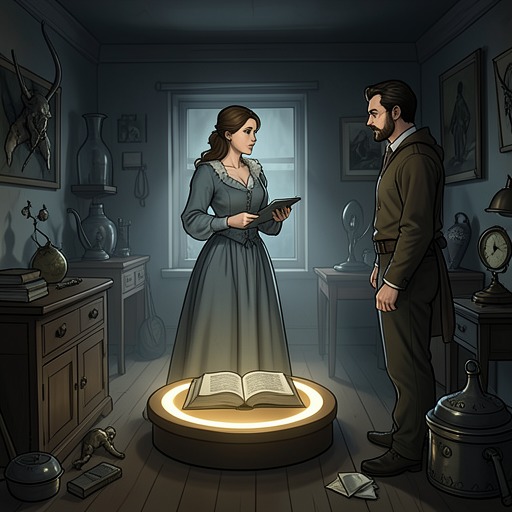
The library is revealed when the elevator opens onto something other than Dominic Vale’s familiar penthouse. Low golden lights flicker like candle flames despite the absence of candles, while the smell of old books, leather, and something darker surrounds Ariella as she steps out. The transition is immediate and disorienting: the corporate modernity associated with Dominic’s public life gives way to an enclosed, ancient atmosphere that feels ceremonial rather than practical.
Its entrance reinforces that displacement. Double doors made of ancient wood stand partly open, carved with strange symbols that Ariella cannot read. The doors are explicitly neither corporate nor modern; their gothic decoration and forgotten-looking script establish the library as a remnant of an older order. The air tingles around her as she crosses the threshold, making the architecture itself seem active and responsive rather than merely decorative.
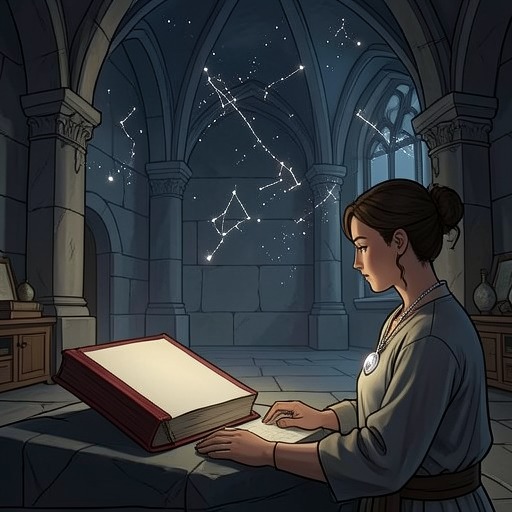
Inside, the room exceeds the category of a normal library. Shelves cover every wall and rise toward a vaulted ceiling painted with constellations that shift slowly, as though breathing. Tall windows are draped in black velvet, and a hearth burns with mesmerizing violet-blue fire. At the center stands a massive obsidian desk veined with silver. These details give the room a singular, almost sacred presence: it is an archive, a ritual chamber, and an embodiment of a world whose laws Ariella does not yet understand.
Dominic Vale’s Legacy and the Library’s Initiation
Ariella recognizes that the room is not merely a collection of books and asks whether it is something more. In response, Dominic explains that he was born into legacy rather than simply wealth, and that true power is older than money and has been in his blood since before the city had a name. The library therefore materializes the history he has concealed behind his identity as a chief executive. It is the physical proof that his authority is hereditary and magical as well as economic.
The revelation changes the meaning of Dominic’s presence. Ariella has known him as a powerful man, but the library presents power on a larger and older scale, one connected to blood, memory, and traditions preceding ordinary language. Dominic’s answer does not provide a complete history of that legacy; instead, the room supplies the atmosphere and objects that make the partial explanation credible. Its silence and symbols preserve knowledge that remains inaccessible to Ariella, even while she is being invited into it.
The initiation is also intimate and hierarchical. Dominic leads Ariella to a heavy leather chair, seats her, and then kneels before her, an inversion that makes the moment visually complex: the predator and king is capable of kneeling, but the gesture does not erase his authority. He tells her that what is occurring is not merely sexual, but involves devotion, trust, and magic. He then retrieves a book bound in crimson leather and opens it to a blank page. The library thus joins erotic intimacy to ritual inscription, presenting the relationship as something that may be recorded, formalized, and magically transformed.
The Hidden Vault and Project Marrow
The library later becomes the destination of a warning rather than an invitation. While Ariella is resting in Dominic’s penthouse, her phone receives a message from an unknown number telling her that Dominic bound her not for protection but to control what he had broken. The message directs her to check the vault beneath the library and ask Luca about Project Marrow. The warning turns the library’s earlier mystery into a possible crime scene and changes Ariella’s relation to the space from fascinated participant to investigative trespasser.
Ariella initially considers deleting the message and returning to the security of Dominic’s bed, but the references to the library and its vault disturb that surrender. She dresses quickly and goes there with a quiet purpose. The journey is significant because the library is no longer only Dominic’s territory: it becomes the place where Ariella chooses to test the story he has given her, even though she does not yet know what the test will reveal.
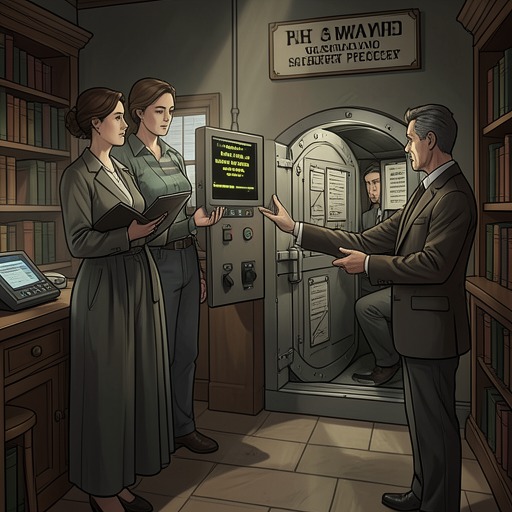
The vault is concealed behind the library’s back wall, and Ariella had not known that it existed. She finds a slight seam in the stone and traces it with her fingers. When her hand touches the central symbol, a vertical slash through a crescent moon, the wall trembles and opens. The mechanism makes secrecy physical. The archive is not simply overlooked; it is designed to remain inaccessible until a hidden sign, touch, or knowledge activates it. The dormant sigils on the floor further suggest that the library contains a ritual system whose power can be active or withheld.
Inside, a single thick file rests on a table. Its bold label identifies it as Project Marrow: Subject A.001. The starkness of the file contrasts with the library’s elaborate beauty. The supernatural room, with its living constellations and violet-blue fire, leads not to an abstract revelation but to a clinical document. The vault therefore joins occult inheritance to bureaucratic classification, showing how magical power can preserve and administer human suffering through records.
Archive of Exploitation and Memory
The file contains the image of a young woman bound in ritual and marked in the same manner as Ariella. Her face is pale and tear-streaked, but her eyes are empty. The resemblance makes the archive personal: Ariella is not reading about a remote historical curiosity but seeing a possible predecessor whose body has been subjected to a process resembling her own.
The report describes accelerated magical adaptation when the subject is bonded with the primary. It states that intimacy significantly amplifies latent channels, while emotional attachment is unnecessary for the bond’s efficacy. The language strips experience from the relationship and translates intimacy into an experimental mechanism. What Dominic has described as devotion, trust, and magic is placed beside a record that treats attachment as expendable and bodily closeness as a means of increasing magical output.
The report’s final disclosure is even more severe: the subject was terminated after attempting to breach the system, and secondary candidates were pending. The library’s archive thus reveals a pattern rather than an isolated incident. The young woman’s disappearance, which aligns with Jenna’s account of a younger former intern who entered Dominic’s orbit believing she had found the job of her dreams, becomes legible as part of a process of selection, bonding, use, and disposal. Jenna’s testimony supplies the human outline; the file supplies the institutional language that attempted to conceal it.
Narrative Function and Aftermath
The library’s importance lies in its double structure. Above and around the characters, it offers sacred silence, shifting stars, velvet, fire, ancient wood, and crimson leather: imagery that makes domination appear beautiful, mysterious, and meaningful. Beneath that surface, the vault contains a file whose cold report exposes a system in which women are reduced to subjects, emotional attachment is declared unnecessary, and failed resistance ends in termination. The same location therefore stages both seduction and indictment.
It also governs the novel’s politics of knowledge. Dominic controls the threshold, the symbols, the ritual objects, and the history that Ariella is allowed to hear. Yet the unknown message creates a breach in that control, and Ariella’s touch opens a physical breach in the wall. The archive can preserve evidence, but access to it depends on hidden routes and acts of defiance. The library consequently becomes a contested space between Dominic’s authority and Ariella’s emerging need to know.
The later fate of Isadora Vale gives the library’s memory function an additional contrast. In the library’s records, a woman is preserved as a marked, empty-eyed subject and then reduced to a termination entry. In the later confrontation, Isadora collapses unconscious after her magic implodes, losing both her power and her memory. Across these connected developments, the story repeatedly links magical control with the ability to erase, classify, or rewrite a person’s past. The Magic Library is where that relationship is first made materially visible: a beautiful archive whose deepest truth is that whoever controls the records can determine which lives remain intelligible and which are made to disappear.